A U.S. phone number may look like a random string of digits, but it follows a tidy pattern. Once you recognize the parts of a phone number, you can tell what each section does and how to dial it correctly from anywhere. Let us take a typical number apart one piece at a time.
The basic parts of a phone number
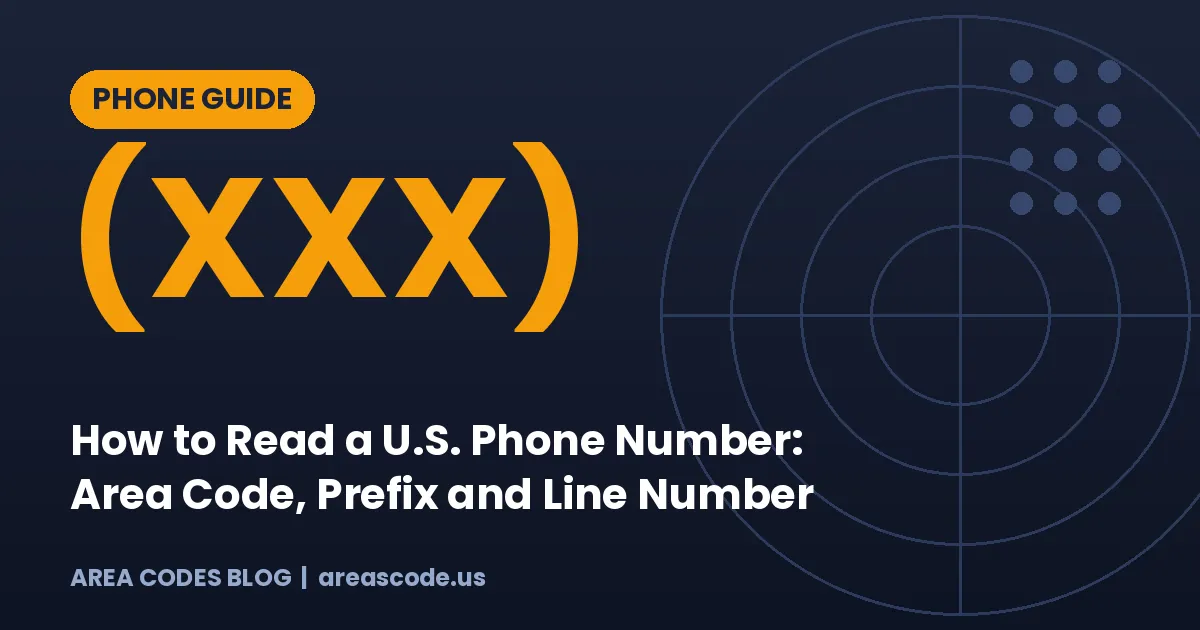
Numbers in the United States are written with ten digits, usually split into groups of three, three and four. The standard way to show them is with brackets and a dash, like this: (212) 555-0123. People in the numbering plan call the sections by technical names, but the everyday names are enough.
- Country code: +1, used only when calling from another country.
- Area code: The first three digits, shown in brackets.
- Prefix: The next three digits.
- Line number: The final four digits.
In our example, 212 is the area code, 555 is the prefix, and 0123 is the line number. With the country code added, the full international form is +1 212 555 0123.
What the area code tells you
The area code is the broadest part of the number. It was originally designed to point to a geographic region, such as a city, a county, or a whole state. Some states are covered by a single code, while large cities may have several. The numbering plan that governs these codes is shared by the United States, Canada, and several Caribbean countries.
There are a few simple rules. An area code never begins with 0 or 1. Codes whose last two digits match, such as 800 or 888, are generally reserved for special uses like toll-free calling. Beyond that, the code tells you where a number was first assigned, not where its owner is today. Mobile numbers go wherever people go, so someone with a Texas code can easily live in Oregon.
The prefix and the line number
The prefix, sometimes called the exchange or central office code, was historically linked to a specific telephone switching office in a town or neighborhood. Like the area code, it cannot begin with 0 or 1. Together, the area code and the prefix identify a block of numbers handed to a particular carrier.
The last four digits are the line number. These pick out the individual customer within that block. Because there are ten thousand possible endings for each prefix, this part gives each number its uniqueness.
It is tempting to treat the prefix as a precise locator, but numbers can be moved between carriers, and wireless and internet calling have blurred the old connections. Treat the prefix as a rough hint, not as proof of anything.
How to dial the parts of a phone number correctly
The way you dial depends on where you are calling from. Here are the common situations.
- Cell phones: Always dial all ten digits. Most mobile phones also accept a leading 1, but it is rarely needed.
- Landlines in the same area: In regions with only one area code, seven digits may still work. Where overlays exist, ten digits are required for every local call.
- Long distance within the country: Dial 1, then the area code and number, if your phone plan or landline requires it.
- From another country: Use your exit code or a plus sign, then 1, then the ten digits.
If you save contacts in your phone with the plus sign and country code, such as +1 and the ten digits, they will work wherever you travel.
Special numbers that break the pattern
Some numbers do not follow the ten-digit pattern. Three-digit codes such as 911 for emergencies and 411 for directory services are short on purpose, because they need to be fast to dial. Toll-free numbers do follow the usual shape, but their first three digits identify a service rather than a place. The pattern also applies to fictional numbers: the range 555-0100 through 555-0199 is set aside for use in movies, books, and examples, which is why you see 555 so often on screen.
Frequently Asked Questions
How many digits are in a U.S. phone number?
Ten digits: a three-digit area code, a three-digit prefix, and a four-digit line number. A leading country code of 1 may be added.
Does the first digit of an area code have special rules?
Yes. It runs from 2 through 9, so area codes never start with 0 or 1. The same is true for the first digit of the prefix.
Can I tell where someone lives from their number?
Only roughly. The area code shows where the number started, but people often keep their numbers when they move.
Knowing how to read a number makes dialing, saving contacts, and spotting suspicious calls much easier. When you want to learn more about a particular code, the lookup at areascode.us will show you the region it covers.